We have been participating in the University of Tampere’s TEOT project, which investigates well-being at work in organizations without supervisors. According to preliminary results, work engagement, satisfaction, and commitment are at exceptionally high levels in self-directed organizations. Vertia’s results were very high on both the self-management and well-being at work metrics, and were also consistently higher than the average results obtained in the study. In this blog post, I’ll explore why Vertia performs so well, and I hope these insights will be useful to other workplaces as well.
Where does workplace well-being come from, anyway?
There are undoubtedly countless factors that influence well-being at work. Personally, however, I believe that once certain fundamentals are in place, other aspects tend to fall into place more easily. So I decided to examine this issue through the lens of the self-determination theory developed by Richard Ryan and Edward Deci.
Autonomy theory is a theory of human motivation, well-being, and basic psychological needs
According to research, most of the life satisfaction and positive emotions people experience can be explained by three basic psychological needs. Meeting these needs is a prerequisite for well-being and optimal development.
According to self-determination theory, the three basic human needs are:
- Self-motivation
- Capability
- Community spirit
Autonomy means that a person is free to decide what to do, and the motivation to act comes from within, not from external pressures or rewards. Competence, on the other hand, is the feeling that one is capable of doing one’s job, overcoming challenges, and getting things done. A sense of community refers to a person’s fundamental need to connect with others. People are caring by nature and also want to feel that others care about them.
How are people’s basic psychological needs met at Vertia?
I would almost go so far as to say that Vertia’s operating model and culture are actually built on these three pillars. I’ll try to explain our operations through these needs.
Self-motivation
Vertia operates on a self-directed model, the core of which is that the staff essentially decides everything themselves—from their own work to the company’s strategy and salaries. The premise is that we have mature adults working here whom we can trust to take responsibility and make sensible choices. So we don’t need managers to make decisions on people’s behalf or to look over their shoulders.
One of the first thoughts we had about our work culture was: why do people need to ask their manager for permission to take time off, for example? Why couldn’t we trust that people are capable of assessing for themselves when it’s appropriate to take a vacation or time off—and when it isn’t? This also led to the question: Could people decide their own work hours, as long as they could align their schedule with the client’s? And couldn’t they work a shorter week if they wanted to, if it supports their personal life situation? And why do people have to come to the workplace in the morning to pick up a car—couldn’t they keep the car in their own yard and drive it straight to the job site, saving everyone time? And finally, do people even need a supervisor at all if they don’t see them all day and decide their own work hours and vacations—couldn’t they also decide on the rest of the matters?
Based on these ideas, our operating model began to evolve toward the self-directed approach it is today.
The guiding principle of our operating model is that everyone has the right to make any decision, as long as they follow the agreed-upon decision-making process. When making decisions, we must always consult those who will be affected by the decision, as well as those with more experience or expertise in the matter. So, if you’re making a decision that only concerns your own work, you can do so without asking others, as long as it doesn’t affect anyone else. Similarly, a team (we call them “cells”) can make a decision among themselves as long as the matter only affects that particular cell. If the matter affects a wider group, people must be given the opportunity to have their say, and this perspective must be taken into account when making the decision. However, this does not mean that decisions require everyone’s approval, as that would lead to endless haggling over even minor issues and drag decisions out into exhaustingly long processes. What matters is that different perspectives are taken into account. The decision-maker can make the final decision based on their best judgment.
In our model, people therefore have the opportunity to act with a high degree of autonomy and influence not only their own work but, in fact, the entire company’s operations. If something needs improvement, everyone has the right—and even the obligation—to improve it, as long as they follow the decision-making process. We have thus bid farewell to those age-old issues that require improvement but simply cannot get the boss’s attention or approval.
For many, however, the biggest advantage is surely the freedom to do things the way they see fit. It makes life easier when you can make arrangements directly with clients or colleagues without needing your boss’s approval—or even any involvement at all—for every little thing. After all, there are no bosses here.
Capability
A few years ago, there was a situation where a new employee, upon joining the company, received only a brief orientation and was quickly assigned to work independently due to a staff shortage. People managed just fine, but without proper orientation, starting the job was stressful, and of course, some gaps in their skills were noticed later on. A couple of years ago, we made a major effort and developed a comprehensive onboarding model that provides thorough, time-intensive training not only on the work itself but also on Vertia’s culture and operating model. We have learned that this is extremely important not only for maintaining a high standard of quality but also for the well-being and satisfaction of our staff, and we no longer cut corners in this area, no matter how busy we are. Today, we are also able to say no to jobs if we do not have enough skilled staff to handle them properly.
At Vertia, job descriptions aren’t set in stone; instead, each person’s role evolves to suit them. When someone joins Vertia, they naturally start by learning the core job they were hired for and focus on that for a while. However, typically after 1–2 years, they begin taking on other tasks based on their own interests and aptitudes, as well as the company’s needs, of course. Some people do have a significant number of roles, but almost everyone also does something else in addition to their main job. Of course, it’s also possible to focus on one thing and become really good at it.
We have used the so-called Hedgehog Concept to help determine which tasks might be suitable for each person. According to the Hedgehog Concept, a good role combines the following elements:
- I'm inspired by what I do (Passion)
- I can become really good at it (Ability)
- What I do is necessary, and it creates value. (Need)
The ideal job description can therefore be found at the intersection of these factors.
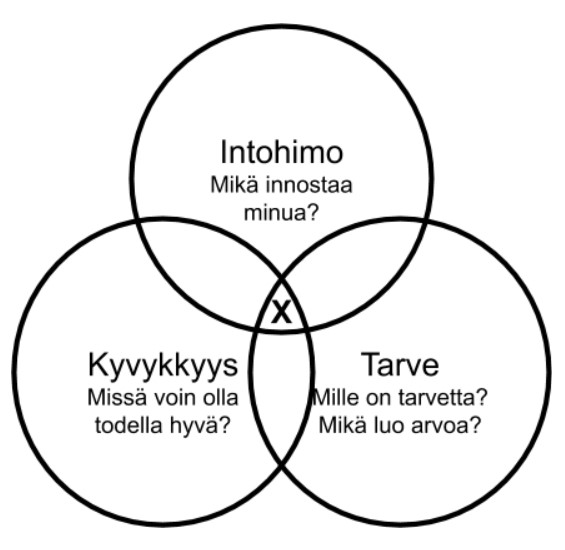
In this way, each person’s role and responsibilities evolve toward a situation where their own passions and abilities align with the needs of the company and its customers.
Community spirit
“Self-management” is a buzzword right now, and we use it too. However, in reality, the Vertia model is better described as “collaborative management.” When making decisions, we take others into account and seek their input. We don’t work in isolation; instead, we’re constantly in touch with one another. Daily communication with coworkers often takes place on our internal messaging platform, Slack, but also over the phone or in person. People see their closest coworkers at least every other week in team meetings, as well as in the weekly joint team council or other joint meetings. We aim to gather once a month for a morning-long company-wide “Sahanteroitus Day,” where we work together to develop the company’s operations, discuss shared matters, and train staff. Of course, during the pandemic, meetings have been held online, but even in these, video calls allow for fairly good interaction, although they obviously don’t fully replace face-to-face meetings.
It’s important to share more than just work-related matters, and this is encouraged through meeting practices, among other things. Meetings often begin with a round of check-ins. Everyone gets a chance to share their thoughts and feelings in general, as well as, of course, regarding the topic of the meeting. It’s comforting to hear that I’m not the only one who didn’t sleep well last night, and on the other hand, it’s liberating to be able to say out loud that I might not be at my best right now. Meetings also end with a group wrap-up. This might seem like an extra step, but it’s extremely important that everyone gets a chance to speak. What is lost in this time is gained in the overall atmosphere and in the fact that even the quieter ones are heard. My own experience is that people genuinely care about each other, and you usually get help when you need it. Of course, there have also been situations where someone has been left alone with their problem, but we’ve worked as a group to figure out how to avoid such situations in the future. As far as I know, however, those are pretty rare.
In my opinion, another important factor affecting a sense of community is the absence of a supervisor. A supervisory position can easily get in the way of genuine interaction. I don’t feel comfortable discussing the same topics with my supervisor as I do with my colleagues. Position also tends to distort interaction: a manager’s word carries weight, and it can be difficult to discuss things on an equal footing. When titles and positions don’t get in the way of interaction, mutual communication is significantly easier, and mutual trust is consequently much stronger.
People create their own workplaces where they can thrive
Finally, I’d like to emphasize one crucial point. Namely, that our operating models were not created by management or owners, nor did we even involve people—rather, the people themselves created these models. Of course, I have been involved in contributing my own perspective and input, but the same rules apply to me as to everyone else. For example, I cannot make unilateral decisions; instead, I must use the decision-making model just like everyone else. When people themselves get to create the practices and operating models for the company, they naturally design them in a way that benefits both themselves and the entire company.
In this blog, I’ve tried to shed some light on why things work so well at Vertia. However, I feel that I’ve only scratched the surface. There are many small and even big factors that influence the big picture, which don’t come across in this text. Hopefully, though, this has given you some food for thought and ideas on how to develop a work community in a more well-being-oriented direction. Feel free to reach out if you’d like to hear more or brainstorm on the topic.
If you’d like to learn more about the research findings from the University of Tampere, you can read about them in this YLE news article: https://yle.fi/uutiset/3-11640042
Are you interested in working at Vertia? Check out our job openings or submit an open application.
Apply for a job