
As of the time of writing this blog post, Vertia has conducted measurements in over 10,000 buildings across Finland. The goal is to continuously increase the amount of data collected from these measurements so that the insights gained from this large volume of data can have an even broader impact on construction quality.
My email signature reads: “Our goal is for everyone in Finland to be able to live in a healthy, energy-efficient, and comfortable home.” We strive to influence this whenever we work on a project, but by compiling and analyzing observations, we can also influence both minor and major details. We are furthest along in this regard with airtightness measurements, but the outlook for the near future looks particularly interesting when it comes to humidity measurements.
Trends in Leakage Rates
For every building we test for airtightness, we create an electronic report using a smartphone, which records information such as the building type (e.g., single-family home / apartment building), number of floors, and exterior wall construction. Based on this data, we can provide our clients with insights into the progress of their construction projects, and we have also made positive observations regarding general industry trends. For example, airtightness figures have improved over time, and the exterior wall structure no longer plays as significant a role in airtightness as it did in the past—careful construction can therefore achieve good airtightness with current materials and practices!
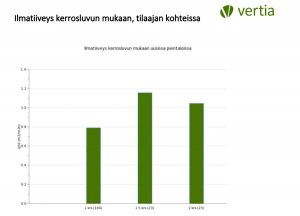
The figure shows an example of a customer's air leakage rates by building floor during the monitoring period
Location and size of leaks
However, simply compiling statistics on air leakage rates does not in itself promote the development of more airtight construction; rather, it is more of a consequence of measures that have been implemented correctly. Detected leak points are reported on a site-by-site basis, but this can easily lead to smaller air leaks—especially those that recur from one site to another—going unnoticed. For this reason, leak location is typically performed during the measurement, and the detected leak locations, along with their magnitude, are also recorded in an electronic report. This data can be used, for example, to provide a house manufacturer or construction company with precise information on potential recurring leak locations based on measurements from the past year.

The image shows an example of air leaks in the roof structure observed at one of our clients' sites during the monitoring period
Concrete drying times
Concrete curing isn’t rocket science, but neither can the readiness for paving be assessed based on calculation formulas or old-school myths like “concrete cures one centimeter per week” (see. Is moisture testing necessary on a single-family home construction site?). As with leak locations, it is difficult to draw conclusions about why a particular case succeeded or failed based on a single instance, because there are so many variables. However, by analyzing a larger set of measurements, it is possible to determine, for example, whether 2.5 months of drying is sufficient for the floor slab of a single-family home.
The goal is to obtain dry results during the first measurement, while still being able to begin the work phases following the paving without unnecessary delays. By analyzing drying times, it is also possible to draw conclusions about, for example, seasonal variations. Contrary to common sense, it is often difficult to get concrete to dry in the summer due to the high humidity in the air, even when there is plenty of heat. In such cases, installing dehumidifiers can help ensure consistent drying times regardless of the season.
Vertia currently uses lightweight tools to monitor concrete curing, but in the near future, our goal is to implement an electronic measurement log similar to the one used for leak testing. This will allow us to gather more precise data on, among other things, pouring schedules, drying conditions, and the mixes used, as well as their impact on achieving sufficient dryness. We hope that the information obtained from this will be useful both for individual projects and for the industry as a whole.
Would you like more information or a quote for this service?
Contact us