
In this blog post, I’ll discuss the use of photography to document vertical drainpipes and ventilation shafts at a new construction site as a quality assurance method.
Utility shafts and their importance in new construction
Modern apartment building construction increasingly relies on prefabricated elements and modules. The most common solution for vertical shafts for sewer and HVAC ducts is prefabricated utility shafts. Prefabricated bathroom modules are also now common, and in terms of vertical shafts, their installation is very similar to that of utility shafts.
The utility shafts are lifted into place with a crane, and the unit comes with pre-installed alignment guides that ensure it is positioned precisely. Connectors are installed at the joints of the drains and ducts, creating a ready-to-use connection when the unit is lowered into place. However, ventilation ducts and especially sewer pipes are very susceptible to breakage at this stage if they are struck or if the alignment is even slightly off. Vertical ducts act as collectors in the system, so any defects in them are immediately very noticeable. For this reason, the ducts are inspected to verify the success of the installation.
When should you have your chimneys inspected?
The earlier the inspection is conducted, the easier it is to fix any defects, especially when painting or fixture installation has not yet begun on the floors. In addition, it is easier to access the ducts with a camera before the roof’s horizontal beams and insulation are installed. Typically, utility ducts are inspected immediately after the roof deck is poured.
Imaging equipment and method
The inspection equipment consists of a cable camera equipped with a high-quality camera at the tip, featuring a wide-angle lens and an LED light. The inspection is conducted from the roof down to the bottom of the drains. All vertical chimneys are recorded on their own video. A report is compiled from the inspection, in which each channel or drain receives a repair recommendation or an “OK” mark. In addition, the distance of the defect locations from the starting point of the inspection—i.e., the roof—is recorded. The drains are also labeled on the floor plan. A browser-accessible link is provided for the video footage itself, making it easy to view the video recording of any potential defects.

A cable camera in Channel IV. A guide is attached to the end of the camera to keep it centered in the pipe.
Most common faults
The most common and most feared defects in this type of inspection are connection failures. In ventilation ducts, these usually manifest as a collapsed joint, while in sewer lines they typically appear when a gasket has come loose from the connection point and is visible. Other defects include, for example, various types of debris at the bottom of the pipes or even stuck in the middle of a vertical riser, as well as smaller dents or dents at the joints or further along the pipe.
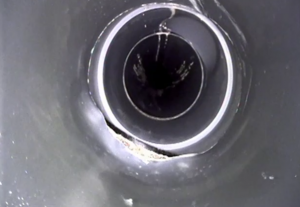
A dent and a partially detached gasket are visible at the joint in the sewer pipe. Further down, the horizontal sewer pipe connects to the vertical sewer pipe.
Fortunately, most vertical flues receive an “OK” rating in the inspection report. Significant joint defects are rare, but all the more significant in terms of construction quality. Correcting such defects usually requires chiseling open the flue at the point of the defect so that the joint can be repaired.
Would you like more information or a quote for this service?
Contact us