
Sound measurement, or acoustic measurement
Good acoustics promote well-being, communication, and performance at home and in the workplace. Sound measurements are conducted in new construction and renovation projects to ensure quality and to identify any potential noise issues.
Airborne sound insulation
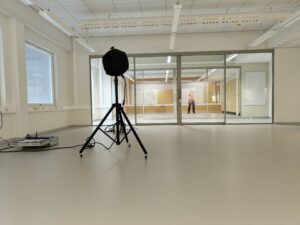
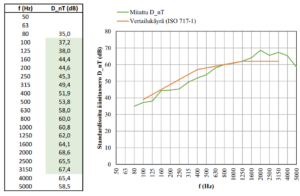
Airborne sound insulation testing determines the sound insulation performance of structures separating rooms with respect to airborne sound. This is typically done between adjacent rooms, apartments, or hallways. A loudspeaker is placed in one room, and the sound is measured from the other room. The resulting sound level difference, DnT,w (dB), indicates the airborne sound insulation between the rooms.
Read more: Airborne sound insulation and sound reduction index
Impact sound insulation
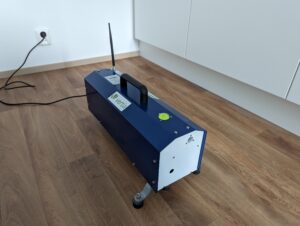
Impact sound insulation measurements are typically used to determine the impact sound insulation between rooms located one above the other. A standardized impact sound tester, specifically designed for this purpose, is placed in the upper room; this device uses small hammers to produce a tapping sound on the floor. This sound is measured from the other room. The resulting impact sound level L’nT,w (dB) indicates the transmission of impact sound between the rooms.
Read more: Impact sound insulation and impact sound index
Reverberation time
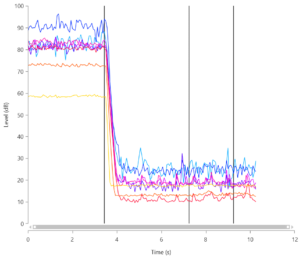
Reverberation is measured by emitting a loud sound from a loudspeaker, interrupting it, and measuring the decay of the sound. The resulting reverberation time, T, indicates the reverberation characteristics of the space. Reverberation is measured in accordance with the SFS-EN ISO 3382-2 standard.
Sound insulation of the facade or balconies
The sound insulation of a facade or balconies can be measured in various ways, either using a loudspeaker or traffic noise. The loudspeaker method determines ΔL (dB), the sound insulation of the facade—that is, the noise-reducing effect of the facade— which is compared to regulatory requirements. Another method is to record actual road traffic noise, e.g., during the day, at night, or over 24 hours (L_Aeq). Ultimately, these methods aim to measure the same thing, but in slightly different ways, and therefore there may be slight differences in the results.
HVAC acceptance measurements, average sound level of room ventilation
HVAC acceptance tests often measure the equivalent sound level L_Aeq (and the maximum sound level L_AFMax) of ventilation in rooms.
Noise measurement
Noise measurements are conducted as outdoor noise measurements, equipment noise measurements, or daytime or nighttime measurements. The choice of measurement method is always determined on a case-by-case basis, as there are various standards and guidelines governing noise measurements. Examples of different types of measurements, which are nevertheless related to one another, are described below.
Equipment noise
Equipment noise measurements can be performed on various types of equipment. When measuring outdoors, the term “environmental noise” is often used, and the measurement method is slightly different (see the section on environmental noise or outdoor noise). The measurement method varies slightly depending on the device, but typically the measurement itself is relatively quick and is performed by moving between measurement points within a room while the device isand off. The measurement can be performed, for example, at the garage door, heating equipment, cooling equipment, or ventilation. A typical measurement is, for example, noise from heating equipment entering an apartment adjacent to or above the heat distribution room. The measurement is performed as a quality assurance check, particularly during the installation of geothermal heating systems, first on the old heating equipmentand finally on the new geothermal heating system, with the aim of demonstrating that the noise level has not deteriorated as a result of the renovation (in addition, airborne sound insulation can be measured for planning purposes).
Environmental noise or outdoor noise
Environmental noise can be measured, for example, at the property line, with the aim generally being to measure the noise generated by a piece of equipment or an industrial facility in outdoor areas (cf. equipment noise). The results are usually compared with the requirements of an environmental permit or a government decision.
Noise at night or other continuous noise
Assessing nighttime noise requires a long measurement period that spans the entire night. A preliminary measurement can be taken over a shorter period. The need for measurement usually arises from the noise experienced by residents while sleeping. The measurement is usually taken near the spot where the sleeper’s head would have been while sleeping. In the same way, daytime noise in rooms can also be measured. Sounds travel through a space as sound waves, so the results vary at different measurement points, and for this reason, measurements are often taken from the location where potential disturbing noise is perceived.