This blog post aims to share some practical insights based on experience regarding the drying times for various types of water damage and building structures.
There are no clear-cut formulas or definitive answers regarding the drying times for water damage; instead, drying times vary depending on the drying method, the extent of the water damage, and the structure. The drying times provided here are therefore estimates based on experience. All or nearly all of the water that has entered the structure should be removed by either dismantling the structures or drying them mechanically or naturally over time.
Lightweight structures
In this context, “lightweight structures” refers to materials such as drywall, hardwood flooring, paneling, or similar materials. In cases of minor damage that is quickly detected, it is possible to dry out lightweight structures. However, if water has penetrated deeper into the structures, the lightweight structures often need to be removed. However, lightweight structures that have been wet for a longer period or have become significantly wet must often be replaced with new ones. Drying times are short, often taking only a few days.
Wooden structures (frame)
Wood is also often easy to dry and dries quickly, provided that other structures have been removed from in front of it and it is allowed to either air out naturally or is dried using dehumidifiers. Even in wooden structures, drying often takes place within a few days, usually within a week at most. Wood is also a good material because it can withstand some moisture stress and can be treated for any damage (e.g., mold removal). However, even with wooden structures, it is worth considering whether demolition and reconstruction would be easier, faster, or more reliable than drying.
The voids in a hollow-core slab
Hollow-core slabs are often used in ground floors, intermediate floors, and roof decks. The concrete in a hollow-core slab is so dense that it can take a long time for water to penetrate through the hollow core. A typical warranty claim damage assessment or the drying is actually related to cavity water, which can be detected in the apartment as damp stains on the ceiling.
The cavity is usually empty, meaning that once any water in the cavity has been drilled out and the dry air produced by the dehumidifier is allowed to circulate freely within the cavity, the drying process is often very rapid. Such a cavity often dries out within a week, in the best cases in just a few days, but we often recommend a measurement period of about a week from the start of drying. Some cavities contain so-called fill castings, which are used for reinforcement or anchoring to secure another structure. Drying these is slightly more challenging and takes longer, but it is still a relatively quick drying process.
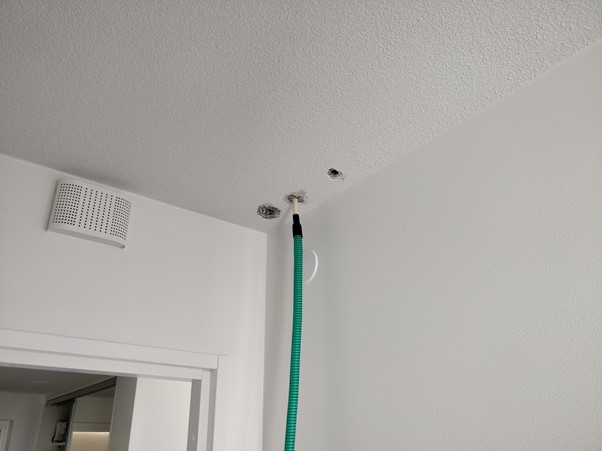
The cavities in hollow core slabs are typically dried by blowing dry air into them using an adsorption dryer.
Concrete Castings
Concrete pours are typically dried using heating panels. In concrete pouring, the amount of moisture and the thickness of the structure are particularly important factors. Concrete layers less than 10 cm thick dry fairly quickly with panel dryers; especially when moisture content is low, drying is often completed in 1–2 weeks. Significantly wetter or more massive concrete structures present a challenge.
Air dryers can also be used instead of panel dryers for drying concrete castings, but they are slower, although they offer the advantages of wide coverage and cost-effectiveness. Air dryers are well-suited for large areas and concrete structures with minimal moisture, or when there is no particular urgency.
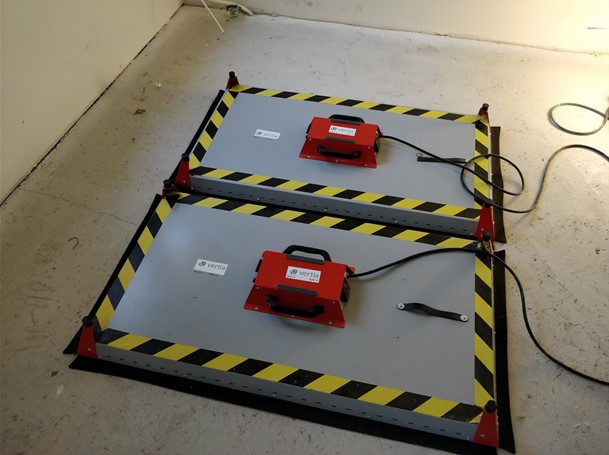
Heating mats—also known as heating panels—are often used to dry concrete pours; these can raise the temperature of the concrete to as high as 90 degrees (adjustable). Read more measuring concrete moisture.
Insulated rooms
There are many different types of insulation, but they can perhaps most easily be divided into hard and soft insulation.
Soft insulation, such as wool batting in walls or ceilings, usually dries quickly. This is simply because air circulation within the structure can usually be easily facilitated. Of course, a separate assessment must be made as to whether the structure can be dried out or whether it should or needs to be demolished; this depends perhaps most on the structures surrounding the insulation space, but also on many other factors.
A solidly insulated space poses a challenge due to air circulation. Blow-dry or suction-dry methods are certainly possible options, but they do not necessarily provide as reliable or rapid drying results as dismantling the structures. For example, a ground or intermediate floor structure where a layer of insulation (e.g., EPS insulation) is placed on top of a hollow-core slab or concrete slab, and a surface concrete pour is placed on top of that, is a structure that is difficult to dry. Often, the solution is to demolish the surface concrete and insulation layer, dry the base slab using panel dryers, and then rebuild. However, the correct solution depends on several factors, such as the structures surrounding the insulation space, the extent of the water damage, and the type of water (clean, gray, or black water).
Summary
The table below lists typical drying times for various types of structures. However, each type of structure and each instance of damage is unique.
| Structure | Typical drying time |
| Lightweight construction, such as drywall | a few days |
| Wooden structure (frame) | a few days to a week |
| Hollow core slab, open | a few days to a week |
| The cavity of a hollow-core slab, partially or fully filled with concrete | 1–2 weeks |
| Concrete pouring, less than 10 cm | 1–2 weeks |
| Concrete pouring, over 10 cm | 1–4 weeks |
| Insulation compartment, soft insulation | a few days to a week |
| Insulated compartment, rigid insulation | 1–4 weeks (drying out the building itself, but this often requires significant demolition and reconstruction work) |
If you have water damage or need help with drying out, please don’t hesitate to contact us. Our team specializes in water damage and will be happy to assist you!
Would you like more information or a quote for this service?
Contact us