
Airborne sound insulation
Airborne sound insulation refers to the attenuation of noise as it travels from one room to another. Airborne sound refers to ordinary noise that travels through the air, such as speech or music.
Footsteps, thuds, and other structural noises are better captured impact sound insulation.
Airborne sound insulation is most commonly measured in new construction and renovation projects, but in some cases it can also be applied to existing buildings.
What is required for measurement
| From the construction site | From a completed property |
| Windows, doors, and other openings are complete (including those in corridors connecting rooms, etc.) | Notifying neighbors (we provide ready-made notices) |
| Electricity is available in both spaces | Electricity is available in both spaces |
| Construction noise was minimal during the measurement (actual recording sessions were short; I was usually able to coordinate with others) | The interior design has no bearing on the result (the space may be empty or furnished in a standard manner) |
Measuring airborne sound insulation
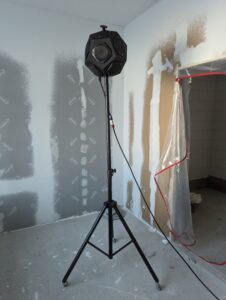
For measurement purposes, it is important that the structures are complete, or at least sufficiently complete for measurement. For example, there should be no remaining gaps or openings—such as those caused by unfinished construction—through which sound could travel from one space to another. This is because the measurement is performed by placing a large omnidirectional loudspeaker in one of the rooms (the sound source room), from which the noise to be measured is generated. For the measurement, the doors, windows, and similar openings in the rooms are, of course, closed.
The noise produced by the loudspeaker is first measured in the sound source room, i.e., the same space where the noise is generated. Afterward, the same noise is measured in the measurement room, which is usually an adjacent, lower, or upper space. The measurement result thus reflects this difference, i.e., the sound insulation of the structures. The measurement is repeated with the speaker in two different positions. As supplementary measurements, background noise is also measured in both rooms, and the reverberation time is measured in the measurement room.
The measurement method is described in the standard SFS-EN ISO 16283-1. The standard also specifies the requirements for measurement equipment.
Airborne sound insulation index and standardized sound level difference
The measurement value established for field measurements and used in various laws and regulations is the standardized sound level difference Dnt,w (previously, the equivalent R’w dB was used).
Since this result was obtained from field measurements, the reading does not reflect the sound insulation of a single structure, such as a wall (compare with laboratory measurements), but rather the combined sound insulation of all surrounding structures, as sound travels from one space to another via lateral transmission (e.g., through floors, doors, hallways, ceilings, or ventilation ducts). Even a small gap in any of these structures can significantly affect the result.
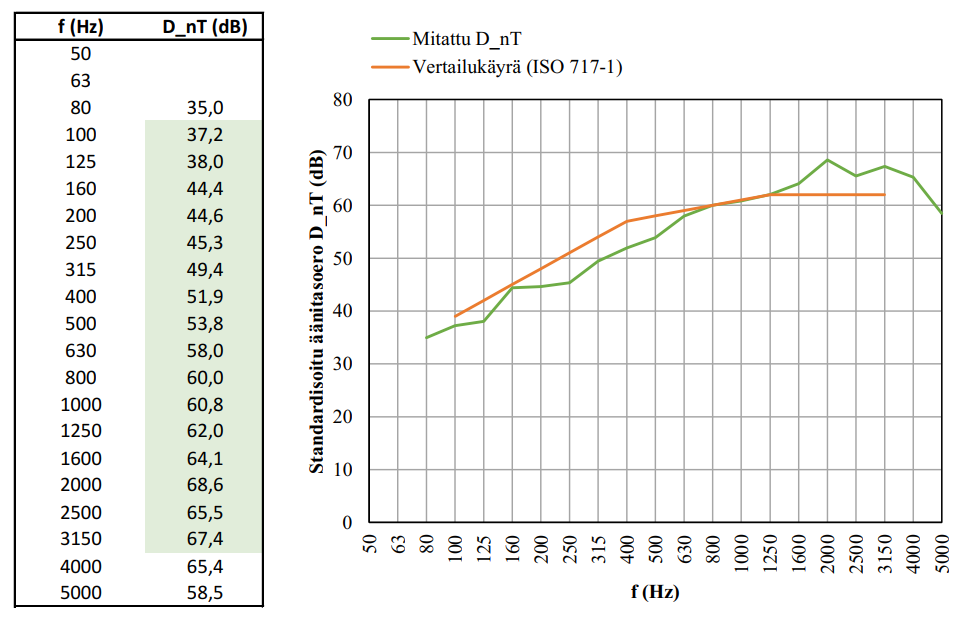
Measurements and analysis of the results are performed across a range of frequencies (100–3150 Hz); in other words, a frequency analysis is conducted when calculating the results. However, the final result is summarized into a single figure that reflects the overall picture.
The higher the Dnt,w (dB) value, the better the sound insulation of the structures.
Airborne sound insulation requirements
Requirements for new construction (796/2017 Decree of the Ministry of the Environment on the Acoustic Environment of Buildings):
| Room size | Minimum permissible sound level difference DnT,w (dB) |
| Between apartments, guest rooms, or patient rooms | 55 |
| From the hallway to a living room, guest room, or patient room | 39 |
Guideline values for other types of buildings are set forth in the Ministry of the Environment’s 2018 guidelines on the acoustic environment of buildings.