
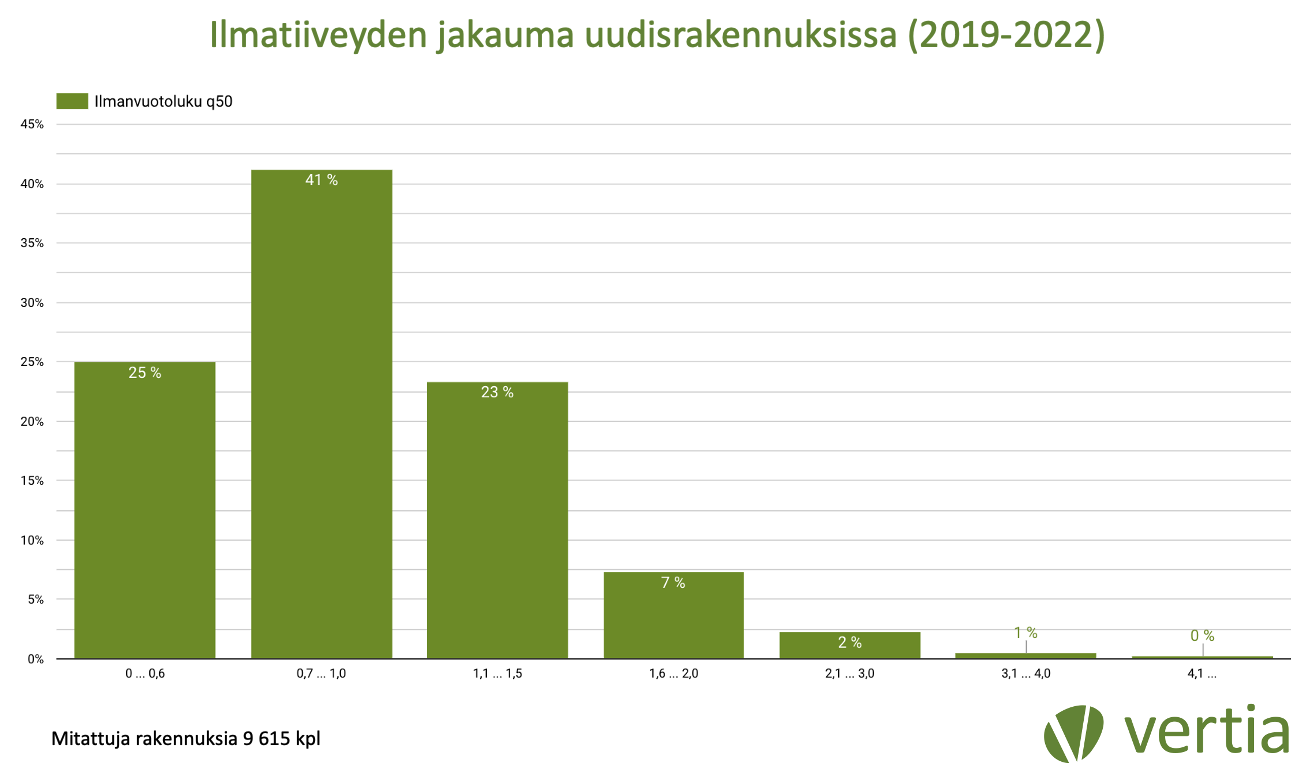
Leak test The result is a building air leakage rate qE50. The air leakage rate indicates the amount of air leakage relative to the surface area of the building envelope (floor, roof, exterior walls, including doors and windows). The lower the number, the better the airtightness.
The air leakage rate is used to calculate a building’s energy consumption and heating power requirements, and when preparing an energy certificate during the building permit phase. If a value lower than 4 is to be used, the airtightness of the building must be demonstrated through an airtightness test or, in the case of prefabricated homes, through a so-called declaration procedure, which is now a rather rare practice. The air leakage rate planned during the design phase is therefore usually verified by an airtightness test before the building is completed, and the measured air leakage rate is updated in the energy certificate. A good airtightness rate demonstrated by measurement is also a valuable document when considering the resale of the home.
A low air leakage rate is easily achieved by carefully sealing the building envelope, so a good airtightness rating is, above all, an indicator of construction quality. It also signifies a low risk of moisture and mold damage and helps reduce drafts. In an airtight house, ventilation also works better, as uncontrolled air leakage does not occur through the structures. A modern, energy-efficient house consists of thick insulation, mechanical ventilation with heat recovery, and excellent airtightness. In particular, all three components of this triad must function well for the system to work effectively. This ensures that the structures remain sound, the indoor air stays clean, and the building achieves high-quality energy efficiency. In an airtight house, the ventilation system must be in continuous operation.
The Effects of Airtightness on Energy Consumption
Use the calculator below to estimate the impact of airtightness on a building’s energy consumption. The calculator is based on the Ministry of the Environment’s decree on the energy efficiency of new buildings and is intended as a guide.
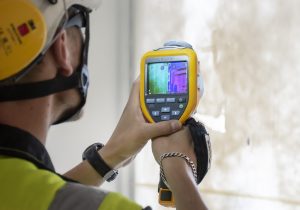
Air leakage rates and leakage locations in new buildings
The average air leakage rate for new buildings measured by Vertia between 2019 and 2022 was 0.98. The sample consisted of 9,615 buildings, representing a significant proportion of all new buildings. In older single-family homes, the average is around 4, though there is considerable variation depending on the construction era and materials, with the airtightness index ranging from approximately 0.5 to 18. However, the majority of new buildings fall below 2.0. Houses that are not measured are likely to have poorer airtightness on average, as leak points are not located in enhanced negative pressure testing.
Air leaks are most commonly found around doors, windows, building joints (e.g., the junction between the roof and the wall), and various penetrations, such as ventilation and electrical installations.
Air leakage testing also yields the building envelope’s n50 air leakage rate, which was used until 2012 instead of the qE50 value. The n50 air leakage rate describes the same concept as qE50, but air leaks are compared to the building’s total air volume rather than the surface area of the exterior envelope. Due to their geometry, large buildings had lower n50 values than small buildings.
A New Service for Builders – Vertia Kanta – The Builder’s Airtightness Database
Check out the new Vertia Kanta service, which compiles statistics from airtightness measurements of new buildings. The service provides air leakage figures for the measured buildings, broken down by building type or wall structure, for example. You can also view the locations of the air leakage points that were found. The service currently includes data on approximately 12,000 properties, and new ones are added daily. You can access the service HERE
If you need a leak test, please don’t hesitate to contact us! Our team specializes in leak testing and leak detection and will be happy to assist you!